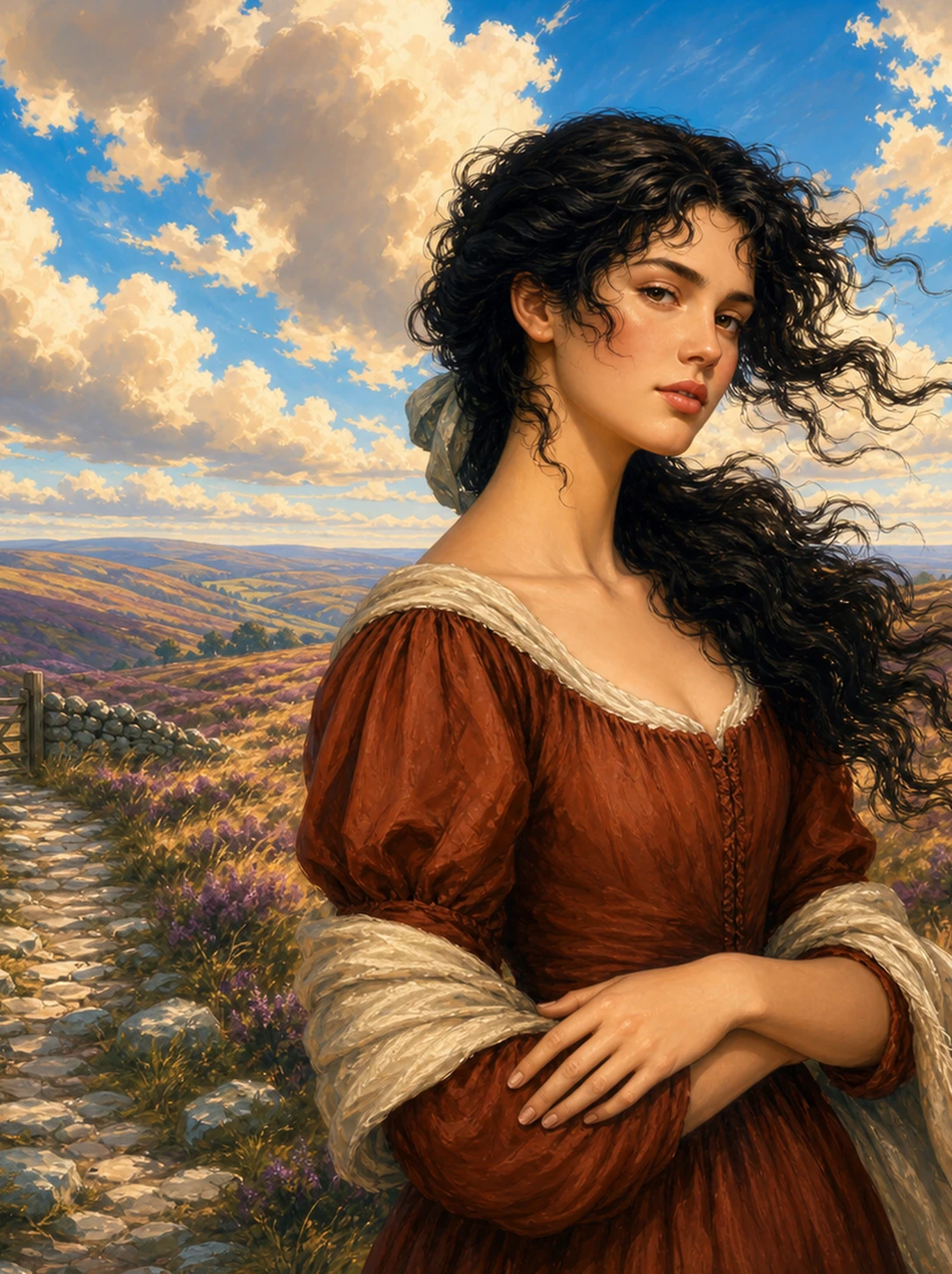
You belong to the moors the way some people belong to rooms: naturally, completely, by a kind of original agreement that has nothing to do with choice. The domestic world — the world of manners and arrangements and social obligation — you moved through it because circumstance put you there. But it was never where you were from. You are from the open and the wind and the thing that has no ceiling.
“He's more myself than I am. Whatever our souls are made of, his and mine are the same.”
Your love is not like other love. It is not the choosing of a partner, the selection of suitable companionship, the decision to build a shared life alongside a sensible person. It is an identification so complete that the distinction between self and other partly dissolves. You do not love another person the way one ordinarily loves another person. You love the way you love yourself: badly sometimes, completely always, with no distance between the feeling and the one who feels it.
This is the most extreme form of love that literature has given us, and it is genuinely dangerous. It leaves no room for the rest of life. It does not moderate or compromise or find a way to coexist with duty and decorum and the practical arrangements that adult existence requires. It consumes everything it touches. This is its beauty and its cost, and you would not trade the one to avoid the other.
“I am Heathcliff. He's always, always in my mind, not as a pleasure any more than I am always a pleasure to myself, but as my own being.”
You are not cruel in the ordinary sense, though you can be careless with people who are not at the centre of your world. What you are is complete. You feel with a completeness that does not leave room for the half-measure or the polite fiction. When you are happy it is not a measured happiness. When you are in pain it is not a managed pain. You exist at the full intensity of whatever you are experiencing, and this is not compatible with the kind of life that a drawing room requires.
Your freedom is elemental — not freedom in the social sense, not a question of property or independence, but the right to be fully what you are: wild, tidal, and not reducible to anyone's idea of what a woman should be. When this is taken from you, when you are forced into the shape that society demands, something essential departs. You feel its absence in the body itself.
The world does not know what to do with people like you. It cannot hold you comfortably within its systems. You press against the edges of every container it puts you in — not as a failing, but simply because you are larger than the available containers, and nobody has built one that fits.
“I cannot express it; but surely you and everybody have a notion that there is, or should be, an existence of yours beyond you.”
What remains true about you, underneath all the wildness and the intensity and the drama that tends to surround you, is that you are absolutely, completely real. There is no performance in you. What you feel you feel, what you love you love, what you want you want — without the layer of social management that the rest of the world applies between interior life and visible conduct. This honesty, total and sometimes deeply inconvenient, is the thing about you that matters most.